
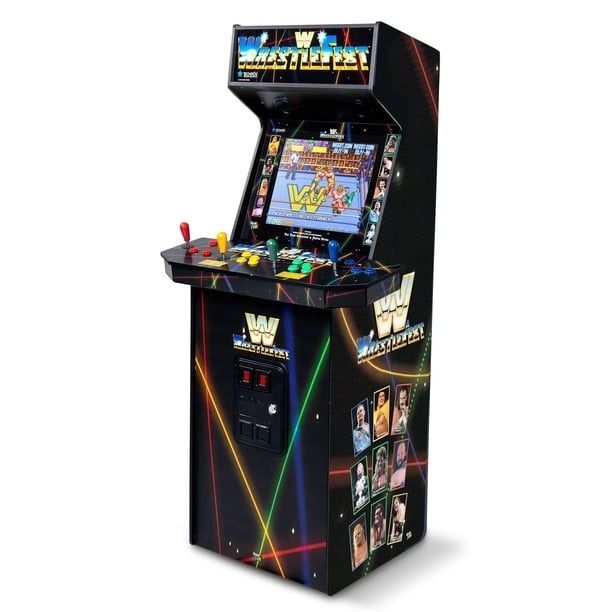
London”s commercial retro bars have perfected the museum version of arcade culture. The cabinets glow, the cocktails arrive with names borrowed from 16-bit history, and a timed game session sits neatly inside a night out priced for the experience economy. These venues can be fun, but their nostalgia is usually frictionless and pre-packaged. Across the city, a more unruly tradition survives in bedrooms, studios, warehouses, garages, art schools, and semi-private gatherings. Here, games are not props. They are handmade invitations to gather, compete, experiment, and make a little mess.
That distinction matters to anyone looking for a London arcade scene beyond commercial nostalgia. The city”s contemporary network stretches from specialist rhythm-game communities and fighting-game dojos to interactive-art exhibitions and maker collectives. Its roots reach back to the Trocadero Underground, once a vast entertainment complex whose SegaWorld and Funland attractions folded games into an immersive urban spectacle. When economic pressures, shifting markets, ownership problems, and public indifference helped bring that era to an end, the culture did not disappear. It dispersed.
What has emerged is less a replacement venue than a living method. A discarded monitor becomes a portal; plywood becomes a control surface; an Arduino becomes an argument about how a game should be played. In a culture increasingly shaped by cloud platforms, algorithmic recommendations, and games designed to sit quietly behind glass, physical interfaces offer a grassroots refusal. They make play visible, awkward, collaborative, and gloriously specific. The point is not to recreate an old arcade perfectly. It is to build a new one from whatever is available.
The visual language of a DIY cabinet begins with salvage. East London maker spaces and independent studios are rich in the materials that commercial venues would reject: bulky CRT monitors, offcuts of plywood, battered MDF, arcade buttons with uncertain histories, USB cables, switches, sensors, and microcontrollers rescued from previous projects. None of this is automatically cheap or simple. CRT screens are heavy, fragile, increasingly difficult to source, and often expensive when authentic scan lines are the goal. Yet their physical presence gives a build character that a thin modern display cannot quite imitate.
A scratch-built cabinet rewards planning before power tools arrive. Builders often begin with a scale model, then translate the design into full-size panels, taking the monitor”s weight and dimensions into account from the beginning. The control deck is where the machine stops being furniture and becomes an instrument. A standard Ms. Pac-Man layout might be replaced by a slanted MDF surface, a cluster of oversized buttons, a crank, a pressure pad, or a hacked object whose purpose is deliberately unclear. As the DIY arcade guide makes clear, choosing controls can require as much research as building the cabinet itself.
The contrast with commercial bar-arcades is revealing. A mass-market machine is engineered for durability, recognisability, maintenance, and rapid player turnover. An artisan cabinet is more likely to prioritise mood, local materials, narrative, or the physical joke embedded in its controls. Its roughness is not necessarily a flaw. Exposed screws, visible wiring, uneven paint, and a marquee printed at home can communicate authorship. The following breakdown shows how different the two approaches can be:
| Element | Commercial bar arcade | DIY or alt-ctrl fabrication |
|---|---|---|
| Display | Modern flat panel chosen for reliability | Scavenged CRT or unusual screen selected for atmosphere |
| Cabinet | Standardised shell built for repeated use | Hand-cut plywood or MDF shaped around a specific game |
| Controls | Familiar joystick and button arrangement | Sensors, switches, pedals, light, fabric, objects, or custom electronics |
| Software | Commercially licensed catalogue or emulation package | Experimental build, prototype, local multiplayer, or art-game installation |
| Maintenance | Centralised service and replacement parts | Community repair, improvisation, documentation, and shared knowledge |
Alt-ctrl design expands this logic beyond the cabinet altogether. The interface may be a table, a wall, a lighting rig, a set of ropes, or a strange physical object that forces players to learn through touch. Tatiana Vilela dos Santos”s discussion of games beyond screens and joysticks describes projects controlled through interactive tables, misleading mazes, and changes in light reaching sensors. These works expose the human-computer interaction loop instead of hiding it. Every movement becomes part of the game”s meaning, and every technical limitation can become a creative constraint.
Modern game design often depends on learned conventions. The left stick moves a character, the right stick moves a camera, shoulder buttons handle secondary actions, and menus behave according to patterns absorbed across decades of controller design. That familiarity can be elegant, but it also narrows the imagination. A custom controller breaks the contract. It asks the player to push, pull, tilt, strike, illuminate, whisper, or collaborate before the rules are fully understood.
The best alt-ctrl games do not add unusual hardware as a novelty layer. They make the physical action inseparable from the idea. A game about instability might require players to balance an object. A work about surveillance could turn a camera or sensor into an uneasy participant. A competitive game might give each player a deliberately asymmetrical tool, making negotiation as important as reflex. This is design with the casing removed, where the relationship between body, object, software, and other people stays exposed.
That openness also creates space for perspectives that mainstream production frequently sidelines. Feminist alt-ctrl practice, for example, treats game-making as a way to examine power, challenge inherited rules, and communicate personal or collective experiences. Courses and workshops in this area combine open tools such as Godot, Arduino, electronics, sound, non-linear writing, and visual design, often welcoming participants without conventional programming backgrounds. The point is not merely to diversify who makes games. It is to question which forms of play have been treated as standard in the first place.
The social effect is especially powerful in a city where much cultural consumption is mediated by headphones and personal screens. A handmade fixture places elbows, knees, voices, and mistakes in the same frame. Players may have to operate one controller together, swap positions, or watch someone else discover the rules. The resulting awkwardness is productive. It turns spectators into collaborators and makes the game a temporary social sculpture rather than an isolated service consumed on demand.
London”s independent arcade culture is deliberately difficult to map. Some spaces are public, some announce events only through trusted networks, and others operate from homes, garages, studios, or borrowed rooms. Their semi-private character is not simply a branding tactic. It can protect the quality of the community by allowing organisers to prioritise trust, care, and continuity over maximum footfall. The underground arcade primer describes this model as a filter: accessible to people who discover it and participate respectfully, but not necessarily designed for indiscriminate traffic.
The city”s visible venues still provide important anchors. Las Vegas Arcade Soho brings Japanese arcade culture underground, with rhythm games such as Pump It Up creating a meeting point for players, competitors, and curious outsiders. FreePlayCity in Manor House has been described as London”s largest arcade, with extensive rhythm and fighting-game collections, tournaments, and a tightly connected regular community. These spaces demonstrate both the vitality and fragility of the scene. Cabinets need constant maintenance, specialised parts are not always easy to obtain, and ownership that feels detached from the players can weaken the culture that keeps a venue alive.
Experimental builds circulate through a wider ecosystem of warehouse parties, art collectives, festivals, workshops, and pop-up exhibitions. London”s Now Play This has helped establish games as exhibition material rather than merely commercial software, while international game-art networks show how alternative controllers, performance, political discussion, and citywide programming can expand the definition of a games event. These gatherings give unfinished work a route into public life. A prototype can be tested, repaired, argued over, and improved in front of the people most likely to understand its ambition.

Trust is not the enemy of openness. In many cases, it is what makes openness possible. A beginner can step into a fighting-game gathering without being treated as a nuisance because regulars have invested in a culture of teaching. A visually strange controller can be approached without fear of ridicule because the room understands that experimentation involves failure. The strongest micro-arcades measure success differently from commercial venues. Progress may mean turning a hesitant newcomer into a regular player, helping a prototype find its audience, or building a community capable of sustaining itself.
The underground arcade matters because physical gathering has become a scarce design resource. Cloud platforms remove logistical friction, mobile games make access instant, and online communities can connect players across continents. None of those conveniences replaces the charged intimacy of standing beside a machine that someone built by hand. A local cabinet creates an encounter with its maker, its materials, its limitations, and the people gathered around it. The game does not simply run. It occupies a place.
For players, the next step is practical: follow independent organisers, attend a workshop, visit a specialist venue, bring curiosity rather than entitlement, and support the people keeping equipment alive. For creators, it may mean trading polished certainty for a rough prototype that can be touched, tested, and misunderstood in useful ways. Every unusual control expands the vocabulary of play. In London”s scattered rooms and improvised arcades, wood, wire, light, and bodies continue to turn gaming into shared cultural work.